Tag: terrorism
Terrorists? Drug Smugglers? How Trump's Corrupt Pardon Promotes Criminal Networks

Terrorists? Drug Smugglers? How Trump's Corrupt Pardon Promotes Criminal Networks

When Donald Trump delivered a full pardon to cryptocurrency billionaire Changpeng Zhao last week, the president didn’t mention the enormous financial favor that Zhao bestowed on the Trump family last July – an investment of $2 billion in World Liberty Financial, the First Family’s big crypto venure.

Instead, when a reporter asked about the pardon of “CZ,” as the crypto mogul is known, Trump portrayed him as a wholly innocent victim of the Biden Justice Department, those “corrupt” and “far left” prosecutors who had targeted the president himself.

“I don't believe I ever met him,” Trump said of his crypto benefactor. “But I've been told, a lot of support, he had a lot of support, and they said that what he did is not even a crime, it wasn't a crime, that he was persecuted by the Biden administration and so I gave him a pardon at the request of a lot of good people.”

One of those good people was of course CZ himself, who commenced his pardon campaign shortly after funneling that multi-billion-dollar investment, financed by Trump’s other friends in the United Arab Emirates, into World Liberty. But the Binance boss was hardly the fall guy in a government witch hunt, to use a Trumpian trope. In fact, he committed serious crimes -- which we know because rather than mount a vigorous defense in court, with all the enormous resources at his disposal, both Zhao and his company negotiated plea deals that resulted in guilty pleas.

The Justice Department generously permitted CZ to plead to a single count of facilitating money laundering, an offense that Binance actually had committed countless times and that formed the basis of its business model. The Binance trading operation, launched in 2017, had grown within four years to become the largest crypto platform in the world by willfully ignoring and evading US anti-money laundering laws.

Zhang’s business model vindicated the warnings of blockchain critics from the very beginning: that crypto’s only obvious uses are to evade taxation and regulation -- and to facilitate crime both here and abroad. Law enforcement officials estimated that “hundreds of millions of dollars in illicit proceeds from ransomware variants, darknet transactions, and various internet-related scams” were routed through Binance to escape detection by US and international authorities.

“For years, Binance allowed users to open accounts and trade without submitting any identifying information beyond an email address,” as the Justice Department explained when it announced Zhao’s plea deal. What this meant in practice was explained in a gloating text message from one Binance executive to another: “we need a banner ‘is washing drug money too hard these days - come to binance, we got cake for you.’”

Indeed, the charging documents in the Binance case recite a litany of international malefactors who routinely exploited its services to carry out their atrocities, from child trafficking and sexual abuse of minors to narcotics smuggling and murderous terrorism. Crypto provided an easy and convenient channel for weapons dealers, espionage agents and terror organizations to evade sanctions on the outlaw regimes in countries like Iran and North Korea that support them.

The most notorious cases involved Hamas, whose leaders employed crypto accounts on Binance to covertly raise millions of dollars between 2019 and 2023 to fund its armed wing, the Izz al Din al Qassam Brigades. Not incidentally, the prosecution and seizure of scores of terrorist crypto accounts – used by Al Qaeda and ISIS as well as Hamas – occurred under the first Trump administration, overseen by former FBI director Christopher Wray and and former Attorney General William Barr.

Unlike that Trump administration, the current version encourages and excuses criminal activity, not only by clearing Changpeng Zhao but by pardoning Ross Ulbricht, whose “Silk Road” dark web entity sold millions of dollars of illicit drugs, and its regulatory leniency toward Justin Sun, another major crypto manipulator who channeled many millions into Trump family enterprises.

Trump is a crony of crypto whose only purpose is to amass billions of dollars for himself, his family and his friends. He has no interest in preventing the abuses – financing terror, abusing children, marketing narcotics – that were so crucial to the founding of a crypto economy. Remember that when you hear him and his minions smearing his critics as “domestic terrorists” or when his “war department” blows a fishing boat out of the Caribbean ocean.

Sadly, those Venezuelan fishermen didn’t figure out a way to pay off the Trumps before they went to sea. They might still be in business, like Changpeng Zhao.

Joe Conason is founder and editor-in-chief of The National Memo. He is also editor-at-large of Type Investigations, a nonprofit investigative reporting organization formerly known as The Investigative Fund. His latest book is The Longest Con: How Grifters, Swindlers and Frauds Hijacked American Conservatism (St. Martin's Press, 2024).

Trump Names 22 Year-Old 'Intern' To Run DHS Counter-Terrorism Program

Trump Names 22 Year-Old 'Intern' To Run DHS Counter-Terrorism Program

When Thomas Fugate graduated from college last year with a degree in politics, he celebrated in a social media post about the exciting opportunities that lay beyond campus life in Texas. “Onward and upward!” he wrote, with an emoji of a rocket shooting into space.

His career blastoff came quickly. A year after graduation, the 22-year-old with no apparent national security expertise is now a Department of Homeland Security official overseeing the government’s main hub for terrorism prevention, including an $18 million grant program intended to help communities combat violent extremism.

The White House appointed Fugate, a former Trump campaign worker who interned at the hard-right Heritage Foundation, to a Homeland Security role that was expanded to include the Center for Prevention Programs and Partnerships. Known as CP3, the office has led nationwide efforts to prevent hate-fueled attacks, school shootings and other forms of targeted violence.

Fugate’s appointment is the latest shock for an office that has been decimated since President Donald Trump returned to the White House and began remaking national security to give it a laser focus on immigration.

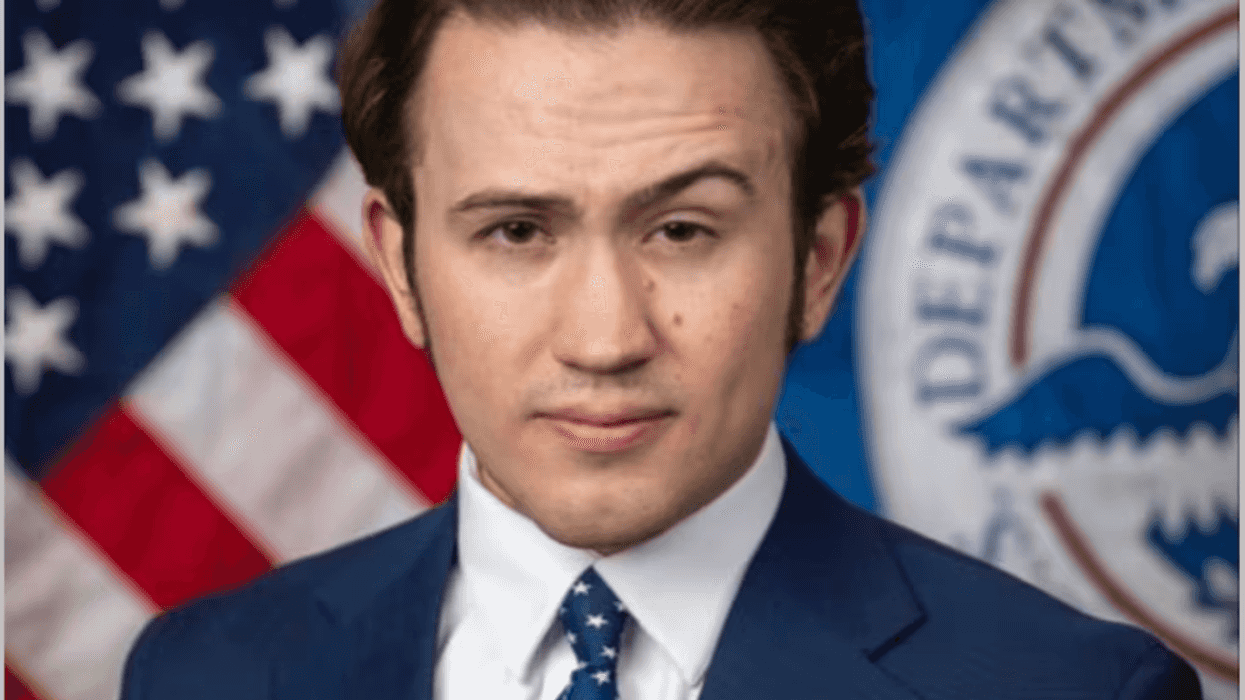
News of the appointment has trickled out in recent weeks, raising alarm among counterterrorism researchers and nonprofit groups funded by CP3. Several said they turned to LinkedIn for intel on Fugate — an unknown in their field — and were stunned to see a photo of “a college kid” with a flag pin on his lapel posing with a sharply arched eyebrow. No threat prevention experience is listed in his employment history.

Typically, people familiar with CP3 say, a candidate that green wouldn’t have gotten an interview for a junior position, much less be hired to run operations. According to LinkedIn, the bulk of Fugate’s leadership experience comes from having served as secretary general of a Model United Nations club.

“Maybe he’s a wunderkind. Maybe he’s Doogie Howser and has everything at 21 years old, or whatever he is, to lead the office. But that’s not likely the case,” said one counterterrorism researcher who has worked with CP3 officials for years. “It sounds like putting the intern in charge.”

In the past seven weeks, at least five high-profile targeted attacks have unfolded across the U.S., including a car bombing in California and the gunning down of two Israeli Embassy aides in Washington. Against this backdrop, current and former national security officials say, the Trump administration’s decision to shift counterterrorism resources to immigration and leave the violence-prevention portfolio to inexperienced appointees is “reckless.”

“We’re entering very dangerous territory,” one longtime U.S. counterterrorism official said.

The fate of CP3 is one example of the fallout from deep cuts that have eliminated public health and violence-prevention initiatives across federal agencies.

The once-bustling office of around 80 employees now has fewer than 20, former staffers say. Grant work stops, then restarts. One senior civil servant was reassigned to the Federal Emergency Management Agency via an email that arrived late on a Saturday.

The office’s mission has changed overnight, with a pivot away from focusing on domestic extremism, especially far-right movements. The “terrorism” category that framed the agency’s work for years was abruptly expanded to include drug cartels, part of what DHS staffers call an overarching message that border security is the only mission that matters. Meanwhile, the Trump administration has largely left terrorism prevention to the states.

ProPublica sent DHS a detailed list of questions about Fugate’s position, his lack of national security experience and the future of the department’s prevention work. A senior agency official replied with a statement saying only that Fugate’s CP3 duties were added to his role as an aide in an Immigration & Border Security office.

“Due to his success, he has been temporarily given additional leadership responsibilities in the Center for Prevention Programs and Partnerships office,” the official wrote in an email. “This is a credit to his work ethic and success on the job.”

ProPublica sought an interview with Fugate through DHS and the White House, but there was no response.

The Trump administration rejects claims of a retreat from terrorism prevention, noting partnerships with law enforcement agencies and swift investigations of recent attacks. “The notion that this single office is responsible for preventing terrorism is not only incorrect, it’s ignorant,” spokesperson Abigail Jackson wrote in an email.

Through intermediaries, ProPublica sought to speak with CP3 employees but received no reply. Talking is risky; tales abound of Homeland Security personnel undergoing lie-detector tests in leak investigations, as Secretary Kristi Noem pledged in March.

Accounts of Fugate’s arrival and the dismantling of CP3 come from current and former Homeland Security personnel, grant recipients and terrorism-prevention advocates who work closely with the office and have at times been confidants for distraught staffers. All spoke on condition of anonymity for fear of reprisal from the Trump administration.

In these circles, two main theories have emerged to explain Fugate’s unusual ascent. One is that the Trump administration rewarded a Gen Z campaign worker with a resume-boosting title that comes with little real power because the office is in shambles.

The other is that the White House installed Fugate to oversee a pivot away from traditional counterterrorism lanes and to steer resources toward MAGA-friendly sheriffs and border security projects before eventually shuttering operations. In this scenario, Fugate was described as “a minder” and “a babysitter.”

DHS did not address a ProPublica question about this characterization.

Rising MAGA Star

The CP3 homepage boasts about the office’s experts in disciplines including emergency management, counterterrorism, public health and social work.

Fugate brings a different qualification prized by the White House: loyalty to the president.

On Instagram, Fugate traced his political awakening to nine years ago, when as a 13-year-old “in a generation deprived of hope, opportunity, and happiness, I saw in one man the capacity for real and lasting change: Donald Trump.”

Fugate is a self-described “Trumplican” who interned for state lawmakers in Austin before graduating magna cum laude a year ago with a degree in politics and law from the University of Texas at San Antonio. Instagram photos and other public information from the past year chronicle his lightning-fast rise in Trump world.

Starting in May 2024, photos show a newly graduated Fugate at a Texas GOP gathering launching his first campaign, a bid for a delegate spot at the Republican National Convention in Milwaukee. He handed out gummy candy and a flier with a photo of him in a tuxedo at Trump’s Mar-a-Lago estate. Fugate won an alternate slot.

The next month, he was in Florida celebrating Trump’s 78th birthday with the Club 47 fan group in West Palm Beach. “I truly wish I could say more about what I’m doing, but more to come soon!” he wrote in a caption, with a smiley emoji in sunglasses.

Posts in the run-up to the election show Fugate spending several weeks in Washington, a time he called “surreal and invigorating.” In July, he attended the Republican convention, sporting the Texas delegation’s signature cowboy hat in photos with MAGA luminaries such as former Cabinet Secretary Ben Carson and then-Rep. Matt Gaetz (R-Fla.).

By late summer, Fugate was posting from the campaign trail as part of Trump’s advance team, pictured at one stop standing behind the candidate in a crowd of young supporters. When Trump won the election, Fugate marked the moment with an emotional post about believing in him “from the very start, even to the scorn and contempt of my peers.”

“Working alongside a dedicated, driven group of folks, we faced every challenge head-on and, together, celebrated a victorious outcome,” Fugate wrote on Instagram.

In February, the White House appointed Fugate as a “special assistant” assigned to an immigration office at Homeland Security. He assumed leadership of CP3 last month to fill a vacancy left by previous Director Bill Braniff, an Army veteran with more than two decades of national security experience who resigned in March when the administration began cutting his staff.

In his final weeks as director, Braniff had publicly defended the office’s achievements, noting the dispersal of nearly $90 million since 2020 to help communities combat extremist violence. According to the office’s 2024 report to Congress, in recent years CP3 grant money was used in more than 1,100 efforts to identify violent extremism at the community level and interrupt the radicalization process.

“CP3 is the inheritor of the primary and founding mission of DHS — to prevent terrorism,” Braniff wrote on LinkedIn when he announced his resignation.

In conversations with colleagues, CP3 staffers have expressed shock at how little Fugate knows about the basics of his role and likened meetings with him to “career counseling.” DHS did not address questions about his level of experience.

One grant recipient called Fugate’s appointment “an insult” to Braniff and a setback in the move toward evidence-based approaches to terrorism prevention, a field still reckoning with post-9/11 work that was unscientific and stigmatizing to Muslims.

“They really started to shift the conversation and shift the public thinking. It was starting to get to the root of the problem,” the grantee said. “Now that’s all gone.”

Critics of Fugate’s appointment stress that their anger isn’t directed at an aspiring politico enjoying a whirlwind entry to Washington. The problem, they say, is the administration’s seemingly cavalier treatment of an office that was funding work on urgent national security concerns.

“The big story here is the undermining of democratic institutions,” a former Homeland Security official said. “Who’s going to volunteer to be the next civil servant if they think their supervisor is an apparatchik?”

Season of Attacks

Spring brought a burst of extremist violence, a trend analysts fear could extend into the summer given inflamed political tensions and the disarray of federal agencies tasked with monitoring threats.

In April, an arson attack targeted Pennsylvania Gov. Josh Shapiro, a Democrat, who blamed the breach on “security failures.” Four days later, a mass shooter stormed onto the Florida State University campus, killing two and wounding six others. The alleged attacker had espoused white supremacist views and used Hitler as a profile picture for a gaming account.

Attacks continued in May with the apparent car bombing of a fertility clinic in California. The suspected assailant, the only fatality, left a screed detailing violent beliefs against life and procreation. A few days later, on May 21, a gunman allegedly radicalized by the war in Gaza killed two Israeli Embassy aides outside a Jewish museum in Washington.

June opened with a firebombing attack in Colorado that wounded 12, including a Holocaust survivor, at a gathering calling for the release of Israeli hostages. The suspect’s charges include a federal hate crime.

If attacks continue at that pace, warn current and former national security officials, cracks will begin to appear in the nation’s pared-down counterterrorism sector.

“If you cut the staff and there are major attacks that lead to a reconsideration, you can’t scale up staff once they’re fired,” said the U.S. counterterrorism official, who opposes the administration’s shift away from prevention.

Contradictory signals are coming out of Homeland Security about the future of CP3 work, especially the grant program. Staffers have told partners in the advocacy world that Fugate plans to roll out another funding cycle soon. The CP3 website still touts the program as the only federal grant “solely dedicated to helping local communities develop and strengthen their capabilities” against terrorism and targeted violence.

But Homeland Security’s budget proposal to Congress for the next fiscal year suggests a bleaker future. The department recommended eliminating the threat-prevention grant program, explaining that it “does not align with DHS priorities.”

The former Homeland Security official said the decision “means that the department founded to prevent terrorism in the United States no longer prioritizes preventing terrorism in the United States.”

Kirsten Berg contributed research.

Reprinted with permission from Alternet.

Deportation 'Error': When Judicial Pigs Fly -- In Formation!

Deportation 'Error': When Judicial Pigs Fly -- In Formation!

Our alleged Supreme Court last night upheld a district court’s order to return the Salvadoran migrant Kilmar Armando Abrego Garcia, whom the government had wrongfully deported to El Salvador, where he has been held in the notorious Terrorism Confinement Center prison for the last 26 days.

“The order properly requires the government to ‘facilitate’ Abrego Garcia’s release from custody in El Salvador and to ensure that his case is handled as it would have been had he not been improperly sent to El Salvador.” The Supreme Court's order, issued in response to an appeal by Garcia that he had been wrongfully seized and deported along with some 200 alleged Venezuelan gang members, cautioned District Court Judge Paula Xinis that she should define more precisely what she had meant by the word “effectuate” in her order to return Garcia, whom she said the government had deported by a “grievous error.”

The Trump administration had alleged without evidence that Garcia is a member of the violent street gang MS-13. Garcia has been a resident of the United States with protected status for 10 years, during which time he has never been arrested. He is married to a U.S. citizen. Judge Xinis found that the “evidence” against Garcia “consisted of nothing more than his Chicago Bulls hat and hoodie and a vague, uncorroborated allegation from a confidential informant claiming he belonged to MS-13’s ‘Western’ clique in New York — a place he has never lived.” Garcia has been a resident of Maryland and claimed never to have been to New York.

For its part, the Trump DOJ admitted in court that Garcia had been deported in an “administrative error” and claimed that there was nothing that could be done to return him to the U.S. because he was being held by a foreign nation, to which the U.S. government had turned him over. Garcia had been given no due process to challenge his deportation under the Alien Enemies Act. In a separate order earlier in the week, Chief Justice John Roberts had temporarily allowed the government to continue using the 200-plus year old law but said that future deportees had to be given due process notice of the proceedings against them and were entitled to challenge their deportation in court. Garcia had been given none of the due process now ordered for future use of the Alien Enemies Act by the Trump administration.

The Supreme Court’s three liberal justices, Sotomayor, Kagan, and Jackson, signed a “statement” as part of the court’s otherwise unsigned order. Justice Sotomayor wrote that the Trump DOJ had asserted that it could refuse to return Garcia to the U.S., against the order of a federal judge, “for no reason recognized by law,” and that the Trump administration position “implies that it could deport and incarcerate any person, including U. S. citizens, without legal consequence, so long as it does so before a court can intervene.” `We could get down in the weeds as to why the court’s order was issued without naming its author or giving even a hint of what the vote might have been, but the most likely reason is that Roberts, Alito, Thomas et. al. had no interest in putting their names on a legal ruling that is bound to draw fire from Donald Trump and his political and legal sycophants.

The Supreme Court’s order in the Garcia matter is a victory for the wrongfully deported Salvadoran migrant but does not address either the fate of the Venezuelans deported along with him or the use of the Alien Enemies act to justify their deportation. The Alien Enemies Act allows the government to deport persons in a “time of war” who are considered dangerous to the country’s national security. There has been no declaration of war against Venezuela or any other country. The deported Venezuelans, many of whom claim they are not gang members and were rounded up on the basis of their soccer team tattoos and nothing else, are not “enemies” under any definition of that word.

How much leeway the Supreme Court will end up giving the Trump administration to use the Alien Enemies Act is not yet known, but today’s order provides hope that at least some due process will be observed in the deportation of migrants from this country. Under today’s order, the Trump administration will be forced to return at least one wrongfully deported migrant, and the court ordered the government to “be prepared to share what it can concerning the steps it has taken and the prospect of further steps” with respect to the return of Garcia. That smells suspiciously like judicial oversight of the Trump DOJ and Department of State, which until this moment have acted in their enforcement of the laws and in judicial proceedings as if they are being run by a criminal gang.

Lucian K. Truscott IV, a graduate of West Point, has had a 50-year career as a journalist, novelist, and screenwriter. He has covered Watergate, the Stonewall riots, and wars in Lebanon, Iraq, and Afghanistan. He is also the author of five bestselling novels. He writes every day at luciantruscott.substack.com and you can follow him on Bluesky @lktiv.bsky.social and on Facebook at Lucian K. Truscott IV. Please consider subscribing to his Substack.

Reprinted with permission from Lucian Truscott Newsletter.

Stephen Miller

Is Funding Freeze A 'Media Hoax' -- Or A 'Gift To Terrorists'?

Stephen Miller, President Donald Trump’s White House deputy chief of staff, is under fire after appearing repeatedly to attempt to whitewash the Office of Management and Budget memo that ordered a funding freeze on “all Federal financial assistance, and other relevant agency activities that may be implicated by the executive orders, including, but not limited to, financial assistance for foreign aid, nongovernmental organizations, DEI, woke gender ideology, and the green new deal.”

The OMB memo, which was not publicly rolled out but rather discovered by journalist Marisa Kabas, appears to have led to the shuttering on Tuesday of the Medicaid portals in all 50 states. There were also reports that in addition to the Medicaid portal, the portal for SNAP, the Supplemental Nutrition Assistance Program formerly known as “food stamps,” also went down on Tuesday, along with other sources or recipients of federal funding.

Miller declared that the massive nationwide concern and confusion were a media creation.

“I can’t help it if left-wing media outlets published a fake news story that caused confusion,” he told CNN’s Jake Tapper. The confusion, Miller insisted, was a “false story” that was “created by the media.”

Later on Tuesday Miller doubled down, declaring on social media, “Welcome to the first dumb media hoax of 2025. OMB ordered a review of funding to NGOs, foreign governments and large discretionary contracts. It explicitly excluded all aid and benefit programs. Leftwing media outright lied and some people fell for the hoax.”

OMB was forced to issue an explainer Tuesday after media outlets accurately reported what the OMB memo stated. But some say that the FAQ was an opportunity for OMB to backtrack after massive, nationwide anger, fear, and confusion — which was somewhat quieted after a federal judge issued a temporary partial pause on the OMB memo.

Rep. Seth Magaziner (D-RI) responded to Miller’s remarks, writing: “They are back-tracking because we spoke up. Good. But make no mistake: their OMB memo ordered a freeze of *all* grants. The Medicaid and SNAP portals went dark. Head Start providers couldn’t draw funds. This was not a coincidence. It was their plan. And they screwed up bigly.”

Despite Miller’s repeated claims that the memo was clear and did not affect a wide array of federally-funded programs, The Boston Globe reported that “Children’s Friend, a Head Start program in Rhode Island, said it was unable to draw down $500,000 for this week’s payroll,” and “Open Door Health, an LGBTQ+ health clinic, said it could not access its federal funds on Tuesday.”

Rep. Magaziner also posted a list of organizations that he says are being blocked from receiving funding by the Trump Department of Homeland Security. “This is a gift to terrorists and our adversaries across the world. Trump needs to stop this madness and resume funding now,” Magaziner, the Homeland Security Ranking Member for Counterterrorism, wrote:

Outrage at Miller’s remarks calling the massive public upset and confusion over OMB’s memo a “dumb media hoax” was extensive.

“Completely false. Your first lie of the year. Payment Management Services (PMS), through which states get Medicaid funds from the federal government, had a banner saying payments were stopped because of Trump’s order. Stop lying,” wrote MSNBC columnist Rotimi Adeoye, whose bio says he is a former congressional aide and advisor for the ACLU Voting Rights Project.

“Sure there are dumb media hoaxes but if you accidentally turn off Medicaid people notice,” observed Matt Stoller, a political commentator, author, and the research director of the American Economic Liberties Project.

Reprinted with permission from Alternet.

Shop our Store

Headlines

Editor's Blog

Corona Virus

Trending

World